
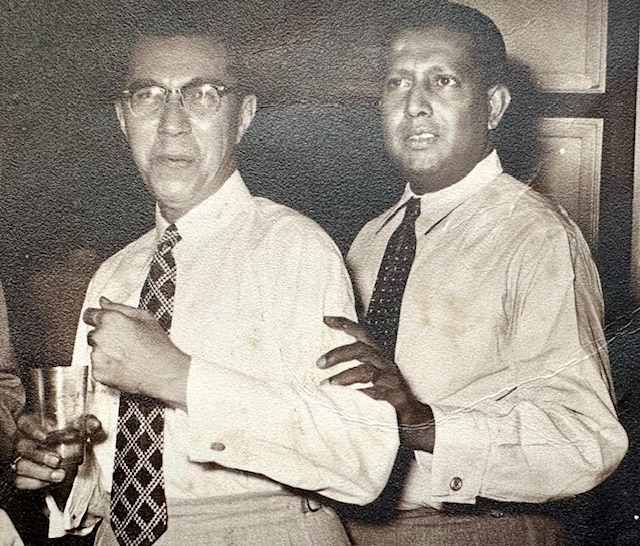
On August 31,1956, Malayan Railwayman Davis Colundasamy Aloysius John had a heart attack in Kuala Lumpur and died. He was 47. He missed Merdeka Day by exactly a year, so never got to see the country of his birth gain independence from Britain.
He also missed my third birthday by 24 days. So I grew up knowing little of the man who was my father. I can’t describe the sound of his voice or the look on his face when he was happy, sad or furious. I don’t know if he sang in the bathroom like I do.
What I have are some small black-and-white photographs of my father that I have looked at again and again as a child, growing up and as an adult and that I brought with me to Singapore when I moved from Kuala Lumpur in 1980.
One, in particular, fascinated me for the longest time. It shows my father standing in front of a brick lighthouse, unsmiling, his hair blown by the breeze, his hands in the pockets of his baggy cotton trousers.
He posed for that picture in Tumpat, Kelantan, at the final stop of the Malayan Railway’s eastern line that once ran all the way from Tanjong Pagar in Singapore to this northeastern corner of the Malay peninsula.
I have been drawn to this picture countless times. My father did not know that day in 1952 that he would have a son the following year, or that his life was so near its end.
The train journey from Kuala Lumpur to Tumpat was a long one. First, he had to ride south from Kuala Lumpur on the west coast of peninsular Malaya all the way to the interchange town of Gemas in Johor, change trains and then travel a. further distance all the way up the east coast to the line’s end.
At Tumpat, the rail tracks run a short distance from the station platform before coming to an abrupt stop. Then there’s just gravel and a fence.
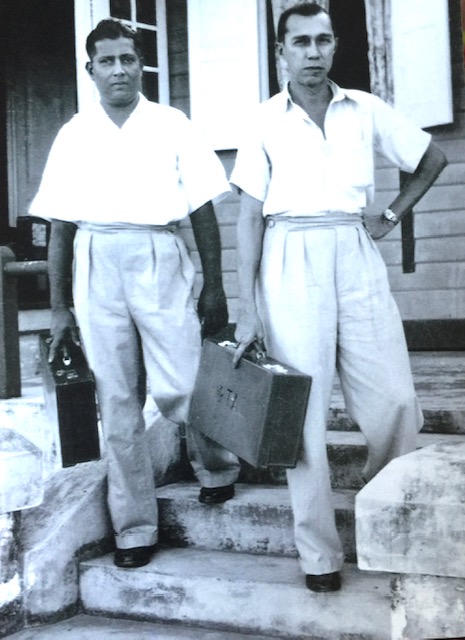
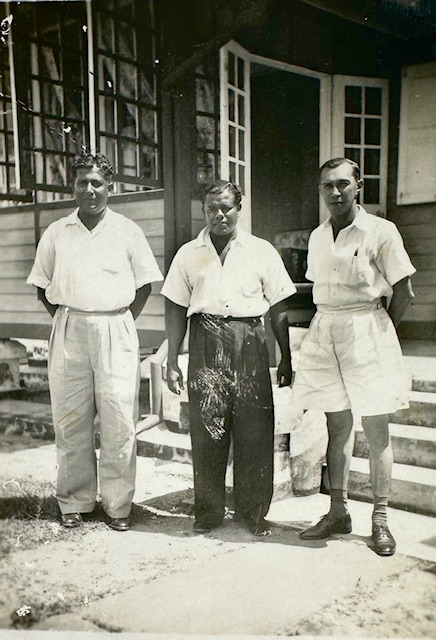
In February 1952 my father was in Tumpat with his Malayan Railways colleague and friend, Henry Lang Taylor.
I don’t know how long they spent in Tumpat, but when the 14 black-and-white photographs were taken, they were staying at the rest house for Railway officers. It is clear from the way these two men appear so comfortable striking various poses indoors and outdoors for an unknown photographer that they were the best of friends.
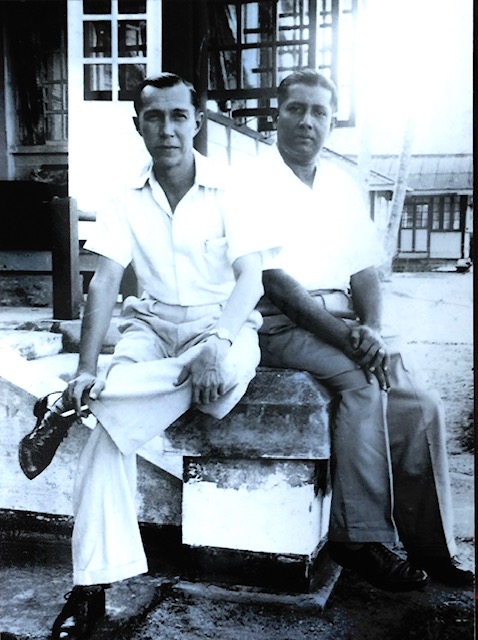
Both were born in 1909 in colonial Malaya. Both were educated at De La Salle schools run by the Christian Brothers – my father at St Francis’ Institution in Malacca, and his friend at St Xavier’s Institution, Penang. Both survived World War Two and the Japanese Occupation. Both worked as Malayan Railways accounts inspectors, visiting stations across Malaya to audit the books.
Both men also married the same woman, my mother Agnes.
When my father died, he left my mother a widow at 26 with four young children – my older sister Barbara and me, and our cousins Dennis and Audrey whom my parents had adopted after their father, my mother’s eldest brother Justin, died.
Our lives were turned upside-down by my father’s sudden death. My sisters were sent to a boarding school in Malacca run by Catholic nuns and my mother who had never worked outside the home took a job as a telephone operator at Braddell & Ramani, a Kuala Lumpur law firm.
My mother’s youngest brother Charlie, a clerk in his mid twenties and not yet married, helped most by letting my mother, Dennis and me move in with him in his government quarters in Jinjang North New Village outside Kuala Lumpur.
Mum received a small pension of about $200 or so, and many times I went with her to the General Post Office in town for her to collect her pension. And she’d tell me: “When you turn 21, this will stop.”
There was an upheaval and breaking away from my father’s side of the family and we would never be close. He was the second of five brothers and although three survived him, none figured in our lives significantly after his death.
My cousin Patrick Albert, son of my father’s younger brother D.C. Albert, filled in some blanks in my father’s story when we reconnected just before the Covid-19 pandemic.
He told me how it was his father who had advised my mother to use whatever payout she received from the Railways after my father died to buy a house.
He said Albert was in town one day when he ran into a colleague who was on his way to buy a house in Petaling Jaya, a new satellite town coming up on the outskirts of Kuala Lumpur.
Albert accompanied his friend and both men ended up buying a semi-detached house each, next to each other in Jalan Carey, for $7,000. Both put the houses up for rent, collecting $50 a month.
When his older brother John died, Albert persuaded his friend and neighbour to sell the house at 27, Jalan Carey to my newly widowed mum so that she and her children would have a home or source of income.
Patrick also wanted to set me right about the relationship between the D.C. brothers, saying they were close, and the younger ones looked up to John. When they met, my father would hold court on all sorts of issues, and the others would listen, Patrick said.
But from where I was, we had little to do with my father’s side of the family over the years that followed.
Our lives changed again on July 4, 1959, when my mother married Henry Lang Taylor, my father’s best friend and the other person in those Tumpat photographs.
My stepfather was Anglo-Indian, Catholic and divorced. He had lost a young son Denis in the war, and his ex-wife had taken their other son, Errol, to live in Perth, Western Australia. He almost never talked about his earlier life.
When my mother married Henry Taylor, it set tongues wagging, to say the least, because in 1959 it was simply not the done thing for a young, Indian, Catholic widow to go off and marry a divorced man. My mother never forgave the people who disapproved.
My stepfather was a homebody and everyone who got to know him could see that he was a good man; it surely takes someone special to marry a widow with four children.
He brought our family together, upgraded our lives by taking us to a new home in the Sentul Railways settlement. The raised bungalow with a large compound on Graeme Road was for the Railways’ mid-level executives.
It was my stepfather who decided I should attend St John’s Institution, the premier Christian Brothers boys’ school in Kuala Lumpur, a move that would have the most long-lasting effect on my life.
My mother and her new husband had two daughters, Elizabeth and Carolyn, and our lives carried on.
Because Malaya gained independence on August 31, 1957, my father’s death anniversary was a public holiday and every year we would make the trip to the Cheras cemetery on Kuala Lumpur’s outskirts to leave flowers and light candles at his grave. I remember more of the cemetery trips than of my father.
There are people who say their earliest memories stretch all the way to infancy, but I’m not one of them. I’ve sometimes wondered if the trauma of his sudden passing wiped out everything I knew of him to the extent that I remember nothing at all.
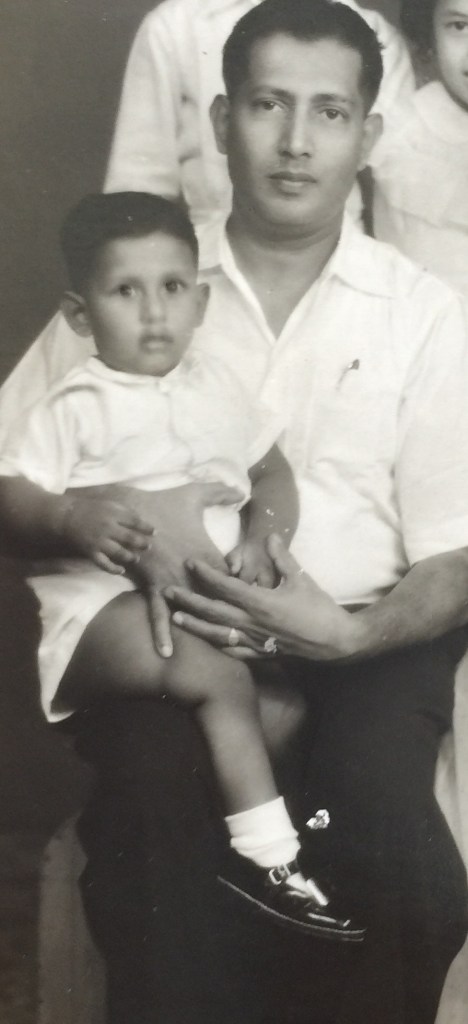
In one family picture taken in a photo studio, I am a toddler on his lap, and he appears calm and unsmiling. We have no informal photographs from the 1950s, so I don’t know what he was like relaxed, in his home clothes. I don’t know if he ever tossed me in the air or kissed me.
Sometimes my mother let on that my father was a dramatic teller of stories who could hold an audience spellbound. Or that he had a terrible temper.
She often described sudden widowhood as the time when she realised she did not know how to do anything because my father had taken care of all important household matters, and even went to the market for the family.
He was always running late to catch the train that took him from our railway quarters to his office, she recalled once. But he worked hard and was honest, which was why he did not leave much when he died. Random snippets from their 10-year marriage.
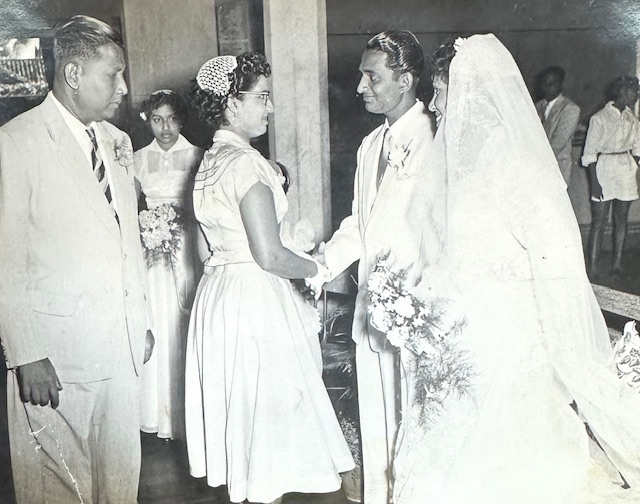
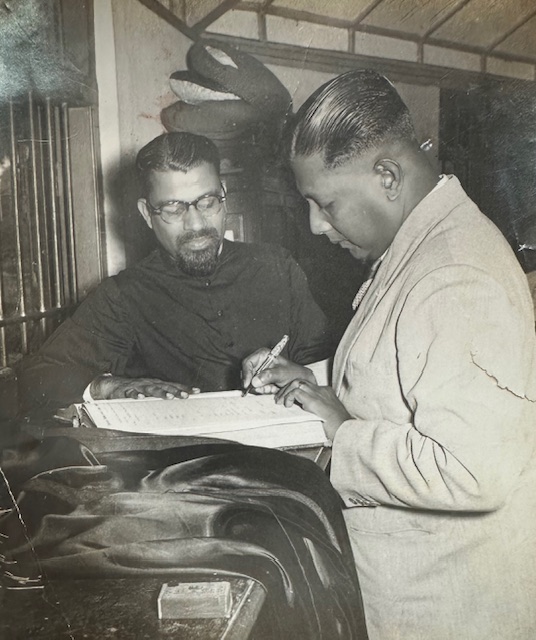
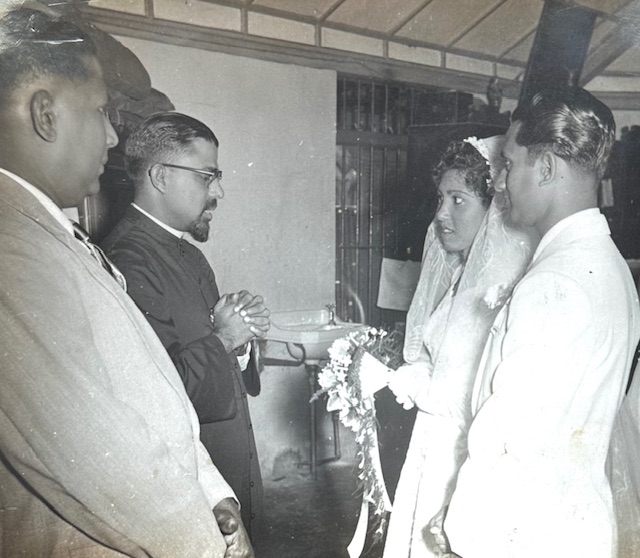
The last photographs of my father are at the wedding of my mother’s brother Teddy John, who married a teacher, Evelyn Lingam. My parents were the witnesses at the marriage, which was consecrated by Catholic priest Noel Clement on November 14, 1955.
My father is dressed in a light-coloured suit, hair gleaming and slicked back, unsmiling in all the photos that have survived. He had less than a year left.
As I grew up, older folk who knew my father would sometimes remark that I looked just like him and for some reason that always felt good. And, as if this was all I needed to know about him, they would tsk sadly and add: “The good die young.”
I did not long to know more about my father and was never aware of a hole in my heart that needed to be filled, and did not ask questions when I could.
But coming across his old photographs, I would always pause, and the older I got, the longer I lingered over the details of my father’s features, his eyes and eyebrows, the shape of his lips and fingers, and the bump on his forehead.
Sometimes it frustrated me that all I could see was a pleasant-faced Indian man who rarely smiled for the camera.
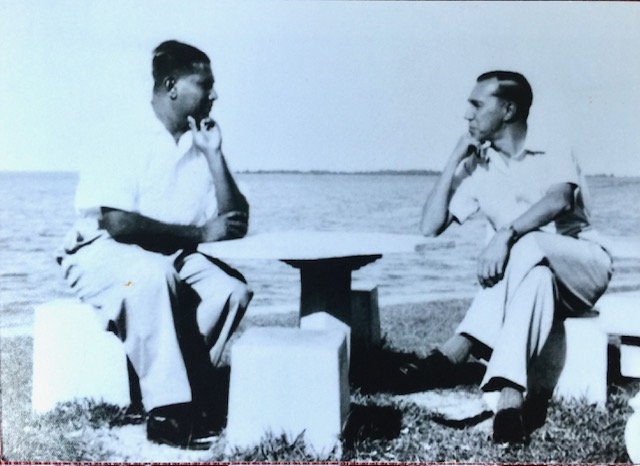
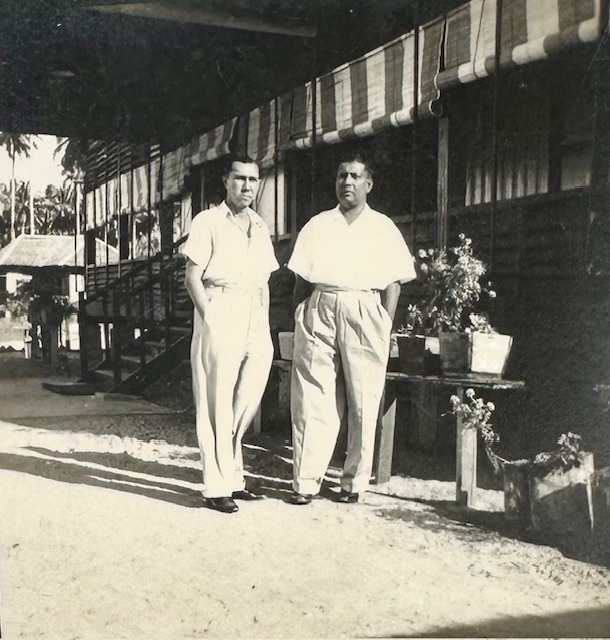
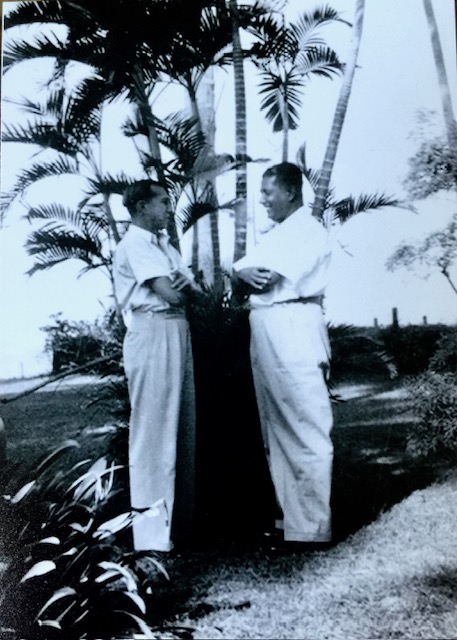
The Tumpat pictures are precious for showing my father and stepfather together. They are not yet 43 years old and they are relaxed and clearly happy despite the absence of smiles.
There are pictures of them at the rest house, having a cup of tea, lounging in large low arm chairs that were the Railways’ standard-issue furniture.
There they are outdoors, standing with arms folded or hands in their pockets, or holding boxy briefcases and pretending to be setting off on a mission.
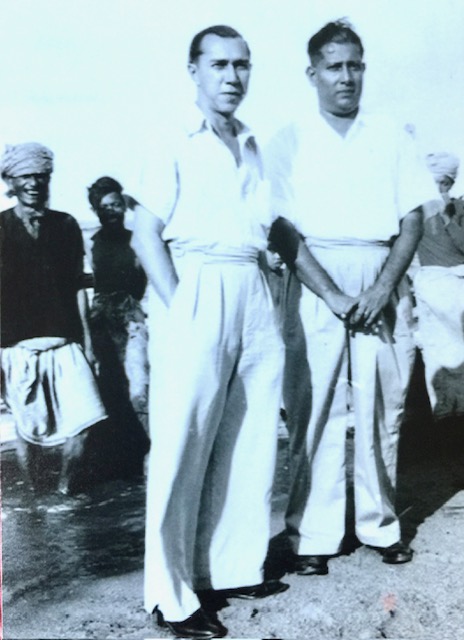
There are also shots in a park and at the seaside, with Kelantanese fishermen in the background. My father wears a grin in only one picture, where he and his friend Henry stand facing each other in front of some palm trees. The hand-written caption on the back says: “A chin-wag in the garden of the Railway Rest House – Tumpat.” It is dated Feb 19, 1952.
I return again and again to the old photograph of my father and the lighthouse. In it, he is alone and stares directly at the camera with no trace of a smile on his face.
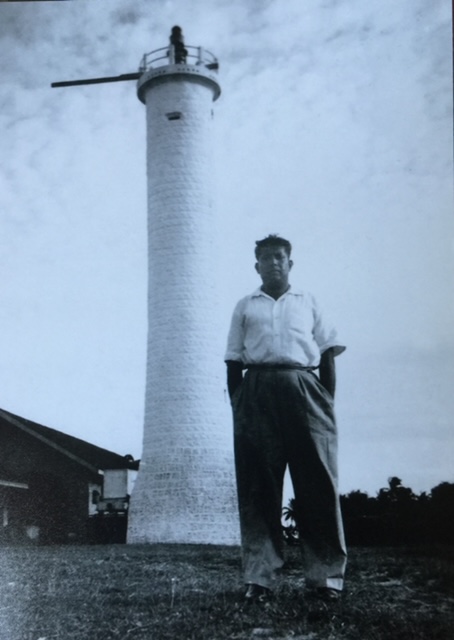
What if he had known that day that he had only four more years to live? How differently would he have spent the remaining time? What would he have stopped doing, started doing? Who would he have treated better?
And after his son arrived, would he have cared that the boy would grow up never knowing him, and might that have prompted him to write a letter to tell me who he was and how he hoped I might remember him?
Would he have described how he and his brothers were orphaned young, or what he felt for each of them?
Would he have told me who he loved truly, and how and why?
Would my father the storyteller have told me a story? His story?
To be continued.
AJ’s note: This is an amended version of My Father’s Lighthouse, which I published in 2016 and which The Sunday Times picked up for publication. It fits in this part of the family story I’ve been piecing together.

