
She was a teenager when she travelled from India to Malaya to marry a man 12 years older. I have so many questions for my beautiful grandmother.
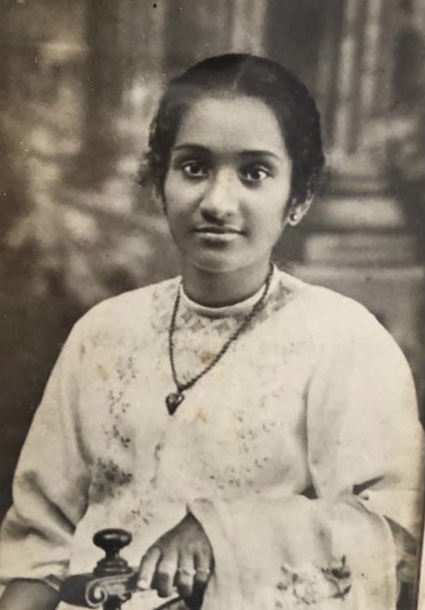
Early on a Wednesday morning, Isabella Rozario woke up, got dressed in her best clothes and was taken to the Church of St John the Evangelist in Kuala Lumpur to get married. It was November 29, 1911.
She had turned 17 two months earlier and was a long way from her birthplace of Trivandrum, in what was then the princely state of Travancore in the southwestern corner of India.
The man she married at 8am that day was Michael Bastian John, who was 29 years old and also from Trivandrum. He had come to Malaya to work in the booming Federated Malay States, and was a draughtsman in the Survey Department.

There is no wedding photograph of Michael and Isabella, no account of who else was present when French missionary Father V.M. Renard pronounced them man and wife, what they did afterwards, or who celebrated with them.
The only photograph that has remained in our family for over a century was taken in a Kuala Lumpur studio at least five years later, perhaps in 1916, and it shows Michael and Isabella with their first child, Ivy Mary, when she was about a year old.
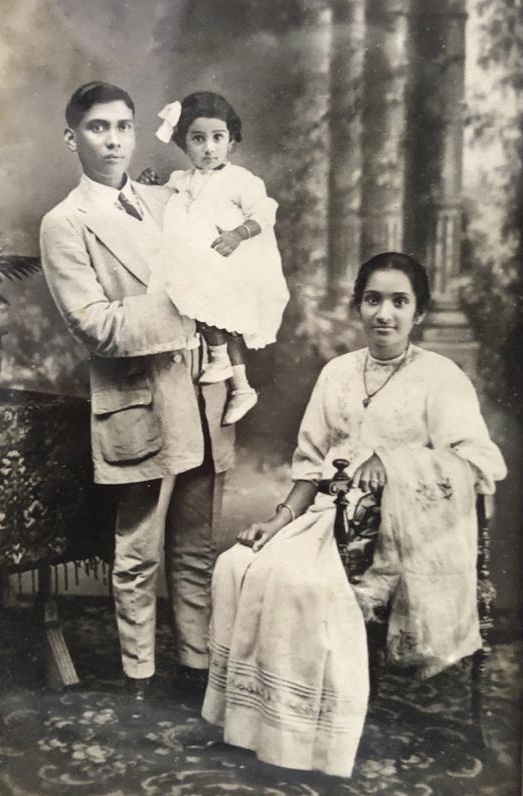
What do you do when you have only one photograph of your grandparents and hardly any details of the 23 years they spent together before both died too young? But don’t they both look splendid here, with my Auntie Ivy, their first child. All the women in our family wore dresses, not saris, and here’s my grandmother Isabella in her fine chatta mundu, the outfit of Christian Malayali women.
Michael, smart in a three-piece cotton suit, stands erect and unsmiling, holding Ivy, a big-eyed doll staring directly into the camera. Is it her birthday? She wears a bow in her hair, a pretty dress with puffy sleeves and a scalloped hemline, a bangle on one wrist, a chain around her neck, socks and shoes.
But it is my grandmother Isabella who stands out in this photograph. She is seated slightly apart from her husband and daughter, dressed in a chatta mundu, the Christian Malayali woman’s outfit of an embroidered blouse and wraparound ankle-length skirt, with an embroidered shawl draped over one arm. She wears a necklace with a heart-shaped locket, stud earrings, a bangle on her right hand and two rings on her left hand. Her hair is parted down the middle and drawn back, perhaps in a low bun.
My grandmother Isabella is beautiful here, and I gazed at this picture countless times throughout my growing up years. My mother Agnes, Michael and Isabella’s youngest daughter, kept it framed at the family altar. Isabella’s gentle, calm expression never failed to make me linger, taking in her sweet features, deepset eyes and that slightest hint of a smile on her lips.
More than a century later, my grandparents remain largely a mystery. Who were they? What were their lives like in India, and who did they leave behind as each embarked on that long journey by ship to Malaya?
Michael had at least two sisters in Malaya. Louisa, four years younger, was married to Davis Colundasamy and already had three sons when Michael married Isabella. Another sister, Agnes, never married but lived with Michael and Isabella throughout their marriage. My mother was named after her, but everyone only referred to this aunt as Amachi.
Isabella, the daughter of Mr and Mrs William Thomas Rozario of Trivandrum, had siblings in Malaya too. Her brothers Victor and William married the Filipino-Eurasian sisters Grace and Geralda Peris respectively. Another brother, Joseph, returned to Trivandrum after some time in Malaya. Isabella also had at least one sister in Malaya. Francina Rozario married assistant plantation manager Paul Pereira, and they had five sons.
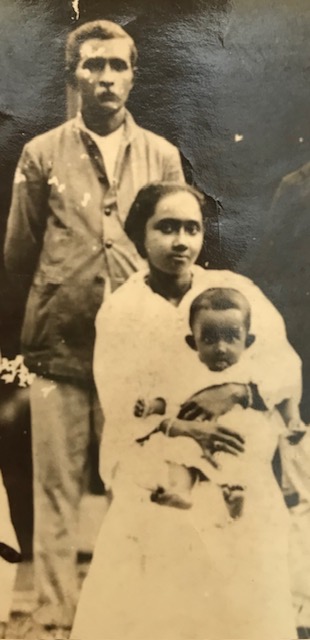
My grandmother’s sister, Francina Rozario, with her husband Paul Pereira, a rubber estate assistant manager, and their son Hubert whom I knew as Uncle Sunno. Francina and Paul had five sons. Photo courtesy of Phyllis Pereira Lopez, daughter of Francina’s son Anthony Pereira, whom everyone called Ando.
Michael and Isabella settled in Kuala Lumpur, living first in a house at 26, Weld Road, near Bukit Nanas, where they were married, before moving to nearby Hicks Road and then to the township of Setapak on the outskirts of town.
There were no children in their first four years of marriage. Then they had six daughters and five sons in quick succession over 15 years from 1915 to 1930. One of the girls, Bertha, died in infancy. When Michael’s widowed sister Louisa died at 36, her five young sons moved in with his growing family for a while too. At some point the boys were sent to the boarding school at St Francis Institution in Malacca.
Michael died on September 20 1934, nine days before he would have turned 53. Twenty-three years after arriving in Malaya to get married, Isabella was now a widow with 10 children aged four to 19. Six years later, on March 3 1941, she died, aged 46.
Their early deaths left so many questions unanswered, not least what they died of. Their children endured World War II and the Japanese Occupation of Malaya from 1942 to 1945, went on to marry and have children of their own, but there were hardly any family stories shared as the years went by.
The silence shrouding the past sometimes felt like this was a family with a secret, or maybe it was one that simply moved on from grief, yearning and loss, dwelt in the present and never looked back.
Neither Michael nor Isabella returned to Travancore during their lifetimes. There was no longing among their children to go to India and visit the place in Kerala that they had come from. Nobody even knew where to look.
There is a story that Michael did well in life and at one point owned two houses in Ceylon Road, near Weld Road, and land in the Petaling outskirts of Kuala Lumpur, but he died in debt, having lost everything in a night of gambling. There are so many more questions that need answers, but nobody said much more.
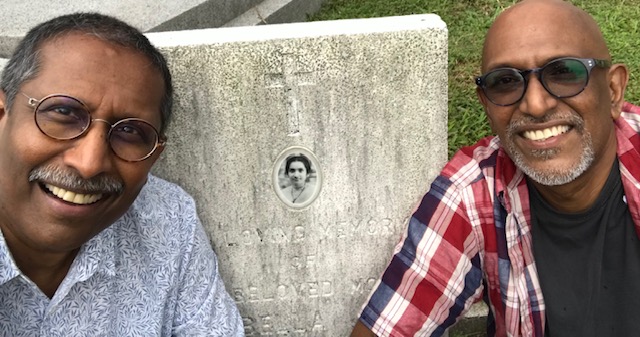
Isabella’s grandsons Alan and Patrick. In 2022, as soon as we could travel again after the Covid-19 pandemic, I visited Isabella’s grave at Kuala Lumpur’s Cheras Christian Cemetery with my cousin Patrick John. His father, Teddy, and my mother, Agnes, were among Isabella’s 11 children. The letters on her tombstone, erected by her sons, had all faded, but her picture was still clear.
Michael was buried in Kuala Lumpur’s old Birch Road Cemetery. I remember visiting his grave maybe once or twice as a child. And later, when I wanted to look for him, nobody was sure where his grave was.
Isabella’s grave has a prominent spot at the top of a hill in the newer Cheras Christian Cemetery, where several other family members are buried. Over the years, all the letters on her tombstone faded away but her picture remained clear enough for passers-by to glance at and say: “What a pretty woman.” But what was that life about? I have so many questions for my grandmother Isabella I could burst.
To be continued: I don’t know where this will go, but I’ll just write down what I know and maybe someday someone else will figure it out.
 Alan John
Do you know if theirs was a happy marriage, Alan?
Phylis
>
LikeLike
Great story John. Keep on writing.
All best to your health and well being, Joyce Yeo aka Mrs Joyce Chee when at SPH
LikeLike
Thank you Joyce!
LikeLike